Free Quotes from Vetted Local Installers
Answer three short questions and get matched with one vetted local installer covering Sutton Coldfield, Solihull and the surrounding areas for a free, no obligation quote.
Sutton Coldfield
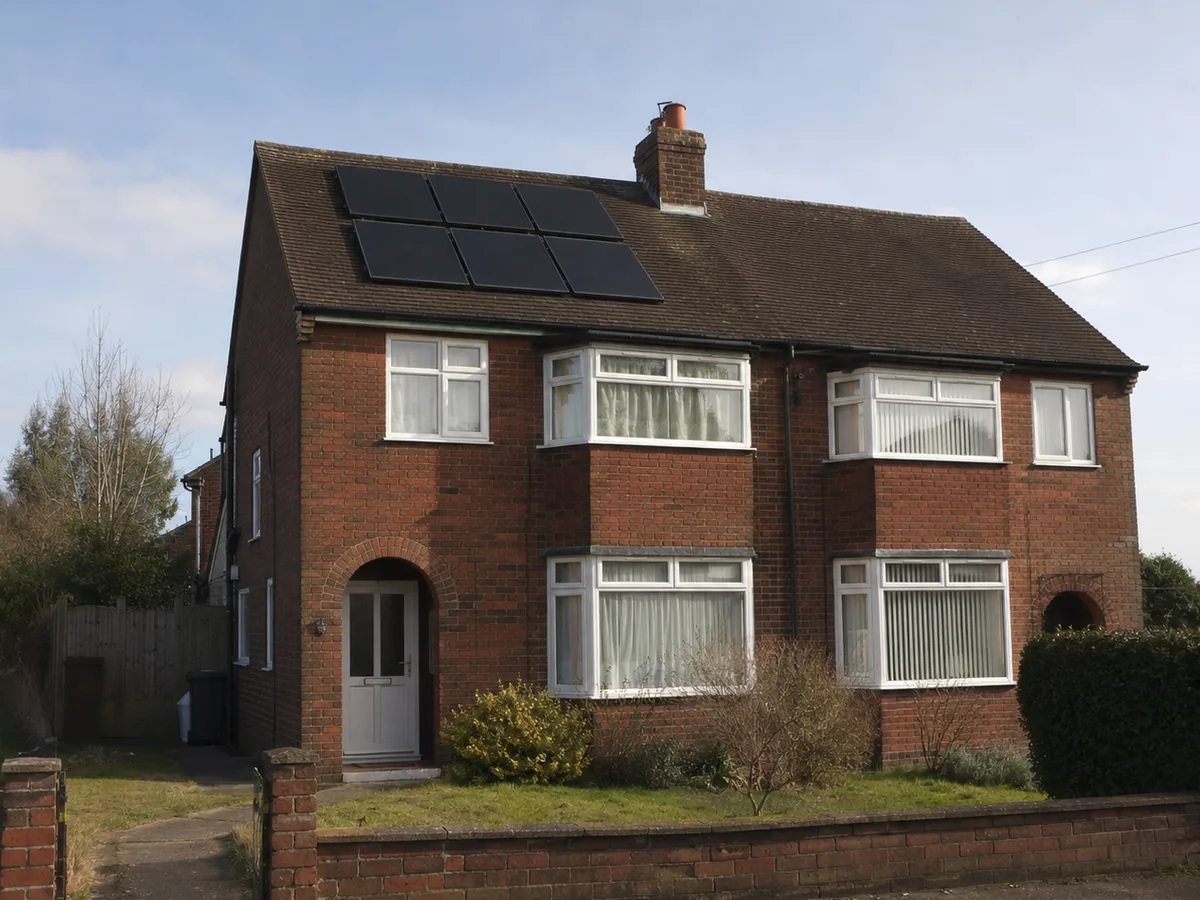
Sutton Coldfield covers a lot of ground and very little of it is uniform. Four Oaks and Mere Green sit at one end of the range, Boldmere and Wylde Green at another, and the roofs vary just as much: Edwardian villas on deep plots, interwar semis with hipped roofs, postwar estates, and modern infill squeezed between all of it. Pitch, orientation, tile type and available roof area differ street by street, and those four things decide what a system produces and what it costs to fit.
For planning purposes Sutton Coldfield is part of Birmingham. Applications go to Birmingham City Council, not to Royal Sutton Coldfield Town Council, which has no planning function. Three of the council's conservation areas fall inside the town: Four Oaks, designated in July 1986 and covering 114 hectares; Anchorage Road, designated in October 1992; and High Street Sutton Coldfield, which additionally carries an Article 4 direction removing permitted development rights that apply elsewhere.
Most roofs in Sutton Coldfield are not affected by any of that. But a quote produced without knowing which of these applies to a specific address is a quote that can change later, which is the practical reason local knowledge is worth something here.
Solihull
Solihull is a separate metropolitan borough with its own planning authority, so the rules that apply to a Solihull address are set by a different council from the one that covers Sutton Coldfield.
That distinction matters more than it sounds. Solihull Metropolitan Borough Council maintains twenty conservation areas across the borough, and the ones most likely to affect a solar enquiry are in the older villages rather than the postwar suburbs. Knowle's conservation area contains 53 statutory listed buildings. Dorridge has two, Station Approach and Granville Road, both covering the late Victorian and Edwardian development that grew up around the railway station. Shirley, by contrast, has no conservation area at all, and its largely twentieth-century housing stock is among the most straightforward in the borough to quote for.
Knowle, Dorridge and Bentley Heath together hold roughly 19,800 people in around 8,000 households, and the council's own local plan describes them as one built-up area inset in the Green Belt about three miles south east of Solihull town centre. Green Belt status does not restrict panels on an existing roof. It does shape what else can be built on a plot, which occasionally matters for ground-mounted arrays.
The Return
For a 4.5 kW system without battery storage, the size Energy Saving Trust gives as typical for a UK home, the annual benefit breaks down like this.
Around half the electricity generated is used directly in the home, roughly 1,913 kWh, replacing units that would otherwise cost 26.32p each.
The remaining 1,913 kWh goes back to the grid under the Smart Export Guarantee, at an assumed tariff of 10.8p per kWh.
Bill savings and export income combined, for a 4.5 kW system on a typical roof.
The model assumes 4,500 kWh under standard test conditions, derated to 3,825 kWh, with half of it used in the home rather than exported. Import rate 26.32p from the Ofgem price cap for 1 October to 31 December 2026, which carries no VAT for the period. Ofgem states costs in this period cannot be compared directly with earlier periods. The 10.8p export rate and the 50% self-consumption share are stated assumptions rather than published figures, and both will vary with your supplier, your tariff and how you use electricity.
The Cost, 2026
Installation cost scales with system size, but not in a straight line. Larger systems cost less per kilowatt because scaffolding, labour and the inverter are much the same job either way.
Smaller systems carry the same fixed costs as larger ones, spread across fewer panels.
The size most domestic quotes in this area are built around.
The band most domestic installations fall into, roughly ten to twenty four panels.
Costs are falling. The average domestic cost per kW dropped from £1,844 in 2024/25 to £1,772 in 2025/26, and the West Midlands sits among the lower cost English regions, around 10% below London.
Installation is zero rated for VAT until 31 March 2027, after which the rate reverts to 5%.
Cost figures from DESNZ solar PV cost statistics for the 2025/26 financial year, drawn from the MCS Installation Database. VAT treatment under The Value Added Tax (Installation of Energy-Saving Materials) Order 2024. Your own quote will differ.
Who You Are Matched With
Solar Panels Birmingham is an introduction service, not an installation company. Enquiries are passed to one vetted local installer, and the installation contract is between you and that installer.
The check that carries the most weight is MCS certification. The Microgeneration Certification Scheme is the UK standard for small scale renewable installations, and it is not administrative box ticking. Without an MCS certificate you cannot register for the Smart Export Guarantee, so you are never paid for the electricity you export. Most manufacturer warranties on panels and inverters depend on certified installation. And the certificate is the evidence the work met the scheme's technical standard, which is exactly what a buyer's solicitor asks for when you come to sell.
The Process
Service, whether you own the property, and your contact details. Around 60 seconds, and no cost.
Your enquiry goes to a single vetted local installer covering your postcode. Not to a panel of five companies.
They contact you to arrange a survey and a written quote. You are under no obligation at any point.
Before You Enquire
Most domestic solar in England does not need a planning application. It is permitted development under Part 14 of the General Permitted Development Order, provided the installation stays inside a set of limits. Those limits were rewritten on 27 August 2026, so guidance published earlier in the year is now out of date on several points.
On a pitched roof, panels must not project more than 0.2 metres beyond the roof slope and must not sit higher than the highest part of the roof, chimneys excluded. On a flat roof the equipment can stand up to 0.6 metres above the highest part of the roof. On a wall the new limits are 0.2 metres where the wall abuts a highway and 0.4 metres otherwise.
Two points matter locally. In a conservation area, the restriction bites on walls, balcony enclosures and roof enclosures that front a highway. Roof slopes are not caught by it, so a conservation area address is usually far less of an obstacle than people expect. Separately, the August rewrite removed permitted development entirely for solar on a listed dwellinghouse, where previously the restriction applied only to buildings in the curtilage. Work that was permitted before 27 August 2026 can still be carried out until 26 August 2027 under a transitional provision.
An Article 4 direction can withdraw these rights for a specific area, and one applies to the High Street Sutton Coldfield conservation area. Listed building consent is a separate requirement and is unaffected by any of the above. If an address falls into any of these categories it is worth confirming with the relevant council before committing to a survey.
Rules under Part 14 of Schedule 2 to the Town and Country Planning (General Permitted Development) (England) Order 2015, as amended by the Amendment Order 2026, in force 27 August 2026. Conservation area designations from Birmingham City Council and Solihull Metropolitan Borough Council.
Worth Considering
On the same 4.5 kW system, storing the surplus takes the annual benefit from £710 to £858: £755 saved on bills and £103 earned from export. Export income falls because less is exported. The battery's own contribution is the difference, around £148 a year, which is the number worth weighing against its cost rather than the headline total.
Battery storage is covered in full on the battery storage page, including sizing, retrofit against installing alongside panels, and what the equipment costs. Sigenergy systems are covered separately.
Questions
Usually not. Roof-mounted panels on a house are permitted development in both towns provided they stay inside the limits set by Part 14 of the General Permitted Development Order. The exceptions are listed buildings, which lost permitted development rights for solar on 27 August 2026, and addresses covered by an Article 4 direction. Sutton Coldfield applications go to Birmingham City Council; Solihull applications go to Solihull Metropolitan Borough Council.
Rarely. The conservation area restriction applies to walls, balcony enclosures and roof enclosures fronting a highway, not to roof slopes. Four Oaks, Anchorage Road and High Street Sutton Coldfield are conservation areas, as are Knowle, Station Approach Dorridge and Granville Road in Solihull, and roof installations in them are generally still permitted development.
Around £7,400 for a 4.5 kW system. Cost per kilowatt falls as the system gets larger, from about £1,955 per kW up to 4 kW to about £1,645 per kW between 4 and 10 kW. Installation is zero rated for VAT until 31 March 2027.
Most domestic installations are completed in one to two days once scaffolding is up. Older or steeper roofs, and properties with restricted access, can take longer.
No. Your enquiry goes to one installer covering your postcode. There is no auction and no list of competing firms calling you.
Yes. Coverage runs across both, including Shirley, Dorridge, Knowle, Four Oaks and Mere Green.
Around 60 seconds to complete. No cost, no obligation, and only one local installer will contact you.
Start My Free Quote